A Professional's Take on the New Acer Chromebook Plus Spin 514
The Acer Chromebook Plus Spin 514 arrives into a crowded market of convertible Chromebooks with a clear brief: blend purposeful build quality, flexible form factor, and a Chrome OS experience tuned for modern workflows. For professionals who split time between browser-based productivity, Android and Linux apps, and frequent travel, a Chromebook that combines versatility with dependable day-to-day performance is appealing. This review examines how the Spin 514 performs in real-world scenarios, what it does well, where compromises are visible, and who should consider it.
Introduction: What buyers expect from a modern Chromebook
Today’s Chromebook buyers typically want a laptop that is fast for web-first workflows, secure and low-maintenance, and flexible enough to serve as both a laptop and a tablet. Productivity users care about keyboard comfort and battery life; hybrid workers and students care about hinge flexibility and display quality; creative professionals who use Android or Linux apps care about sufficient CPU and memory and a responsive touchscreen. The Acer Chromebook Plus Spin 514 is positioned to answer many of those needs with a convertible design and a Chrome OS configuration that aims to offer more than the bare minimum.
Design and build: Durable, professional, and convertible
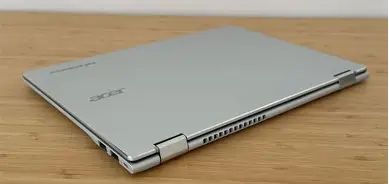
Physically, the Spin 514 follows the Spin lineage: a 360-degree hinge that converts between laptop, tent, stand, and tablet modes. The chassis feels more substantial than entry-level plastic Chromebooks, leaning toward a metal or metal-reinforced construction that conveys a professional feel. That matters in real-world use — a laptop that lives in carry-on bags, conference rooms, and classroom backpacks needs to resist scuffs and wobble while in use.
For day-to-day handling: the hinge provides predictable resistance and the touchscreen responds well to touch and stylus input where supported. The keyboard deck is typically firm with decent key travel for extended typing sessions, and the trackpad is large and precise enough for Chrome OS gestures. Port selection on convertible Chromebooks can be a differentiator; the Spin 514 usually has a sensible mix of USB-C, USB-A, and a headphone jack, which reduces pockets of dongles for users who still juggle wired accessories.
Display and input: Practical for productivity and media
Chromebook screens are judged on clarity, color, and usable aspect ratio. The Spin 514 places emphasis on an experience tuned for productivity: a bright touchscreen with sensible color reproduction and viewing angles. For spreadsheet work, text editing, and split-screen multitasking, the panel provides good contrast and sufficient resolution to keep UI elements crisp without overwhelming battery life.
Touch responsiveness and stylus support make the device suitable for quick annotations, note-taking, and light sketching. Professionals who rely on precise color grading or high-end visual work will want to confirm panel specifications for their needs, but for everyday content, presentations, and video calls the display is more than adequate.
Performance and software: Chrome OS optimized
Under the hood, the Chromebook Plus Spin 514 is designed for web-centric tasks: multiple browser tabs, Google Workspace apps, Slack, and Zoom-style video conferencing. Chrome OS’s lightweight architecture keeps the device feeling nimble. The "Plus" designation generally indicates a higher tier of hardware or additional Google-validated features compared to entry-level Chromebooks — in practice this translates to smoother multitasking, better Android app behavior, and longer update commitments in some cases.
For developers or advanced users who enable Linux (via Crostini) or run heavier Android apps, performance scales with available CPU cores and memory. Buyers who expect to run virtualized development environments or large local builds should opt for higher memory and storage configurations; the base configuration is well-suited for writing, web development, and lightweight photo editing using Android or web apps.
Discover deals on Laptops & Computers — updated daily.
Browse Now →Battery life and thermals: Practical endurance
Battery life is one of the most practical measures for traveling professionals and students. The Spin 514 aims to balance brightness and longevity so users can get through a workday of meetings, emails, and web research without hunting for a socket. Real-world endurance depends on workload — many users will see the best results with balanced brightness and conservative multitasking, while heavy video conferencing and large numbers of background tabs reduce runtime.
Thermal performance is engineered to keep the chassis cool during extended sessions. Chrome OS usually reduces background CPU contention, which helps maintain comfortable surface temperatures even under sustained loads. Users who push the CPU for extended compilation or media transcoding should expect higher fan activity and warmer surfaces, as with any thin convertible design.
Connectivity and peripherals
Professionals often care about connectivity: a full-size USB-A port is handy for older peripherals, and dual USB-C ports support charging, data, and external displays. Built-in Wi‑Fi and optional mobile broadband support (depending on configuration) are essential for remote work. The inclusion of Bluetooth and a reliable webcam and microphones is crucial; Chromebook buyers will appreciate clear video call audio and a webcam that performs decently in typical indoor lighting.
Security and manageability
Chrome OS itself is an advantage for business and education: sandboxing, automatic updates, verified boot, and easy centralized management for IT teams. The Spin 514 benefits from these platform-level protections, making it an easy pick for organizations that want low-overhead devices that stay current with security patches without manual intervention.
Real-world use cases
- Remote worker / digital nomad: The Spin 514’s convertible design and light footprint fit travel-oriented work. It can serve as a compact productivity machine on flights and in co-working spaces.
- Student / classroom: Touch and pen support enable note-taking and in-class collaboration. Chrome OS simplicity reduces administrative overhead for IT managers in education.
- Sales and field professionals: Hinged tent and tablet modes make it easy to present or collect signatures on the go, while long battery life keeps the device useful throughout a busy day.
- Developer / maker: For light web development and containerized work, the Spin 514 handles common Linux and Android developer workflows. Heavy compilation and large builds are better suited to higher-power laptops.
- Content consumer with occasional content creation: The machine is well-suited for streaming, video calls, and light photo editing with Android or web-based tools.
Pros & Cons
- Pros
- Versatile 2-in-1 design with reliable 360° hinge for multiple modes of use.
- Solid build quality and a professional aesthetic that stands up to daily handling.
- Chrome OS offers fast boot times, strong security, and low maintenance.
- Touchscreen and stylus-ready input expand utility for notes and quick edits.
- Sensible port selection reduces dependence on adapters for most users.
- Cons
- Not aimed at high-end creative professionals who require color-accurate displays or discrete GPUs.
- Configuration choices (RAM/storage) matter — low-end trims can feel constrained under heavier multitasking.
- Chrome OS has a different app ecosystem than Windows or macOS; power users reliant on specific desktop apps may need alternatives.
- Convertible designs sometimes sacrifice thermal headroom compared with thicker clamshell laptops.
How the Spin 514 compares (qualitative table)
| Aspect | Acer Chromebook Plus Spin 514 | Typical Ultraportable Chromebook | Entry-level Windows Ultrabook |
|---|---|---|---|
| Form factor | Convertible 2-in-1 with sturdy hinge; usable as tablet and laptop | Often clamshell or weaker hinge convertibles | Clamshell-focused; fewer tablet-style interactions |
| Performance for web apps | Smooth for multitasking and web productivity | Capable but may be limited on heavy multitasking | Comparable or stronger for CPU-heavy local apps |
| Battery life | Balanced for a full workday under typical use | Generally good, varies by configuration | Varies widely; some models optimize for long runtime |
| Software ecosystem | Chrome OS with Android and Linux app support | Chrome OS; varying update commitments | Windows desktop ecosystem; broadest app support |
| Manageability & security | Strong (automatic updates, verified boot) | Strong | Depends on vendor and IT setup |
| Price-to-performance | Competitive for a well-rounded convertible | Often lower cost, but with compromises | Higher variance; some budget models undercut Chromebooks |
Buying guide: What to prioritize when considering the Spin 514
When evaluating the Acer Chromebook Plus Spin 514, buyers should focus on the following categories to match the device to their needs.
1. Intended workload
If the primary tasks are web-based productivity, email, document editing, and video calls, the Spin 514 is a strong fit. For sustained CPU/GPU-heavy workloads (large media exports, complex 3D rendering, or large local compiles), consider a purpose-built Windows or macOS workstation instead.
2. Memory and storage
Chrome OS benefits from more RAM when users keep many browser tabs and apps open. For power users who run Linux containers or many Android apps concurrently, prioritize the highest RAM option available. Storage is less critical for cloud-first workflows, but faster local storage improves responsiveness when offline or when handling local files.
3. Display quality and size
Choose the display configuration that matches workflow needs: higher brightness and better color are worthwhile for frequent media consumption and presentations. If portability and long battery life are paramount, balance between resolution and power draw.
Shop the latest Laptops & Computers picks on Amazon.
View Offers →4. Ports and expandability
Confirm the port selection — USB-C ports that support charging and displays simplify docking, while at least one USB-A port reduces the need for dongles. If frequent external displays are part of the workflow, ensure the configuration supports the necessary output modes.
5. Stylus and touch
Professionals who annotate documents, take handwritten notes, or sketch will value a model with active stylus support and low latency. Verify whether a stylus is included or sold separately and whether the display supports palm rejection for comfortable inking.
6. Connectivity options
For users who travel or often work where Wi‑Fi is unreliable, models with optional mobile broadband are beneficial. Otherwise, prioritize strong Wi‑Fi performance and latest-generation Bluetooth for peripherals.
7. Warranty and update policy
Chromebooks receive automatic security and OS updates for a set period. Confirm the update end date for the model being considered and check warranty terms if deployability and long-term maintenance are important for business purchases.
Practical tips for buyers
- When testing the keyboard, type sample paragraphs and use the touchpad to move between tabs — comfort during extended typing sessions matters more than small spec differences.
- Open multiple tabs and run a video call to gauge real-world performance rather than relying solely on benchmarks.
- Try enabling Linux containers if developer workflows are important to ensure the specific configuration meets performance expectations.
- Consider the trade-offs between a slightly heavier chassis with better thermals versus the lightest possible option; long-term comfort and performance stability matter in professional use.
Conclusion
The Acer Chromebook Plus Spin 514 is a purposeful convertible that answers the core needs of many modern professionals: secure, low-maintenance software, flexible modes for varied workflows, and a level of build quality that suits the rigors of travel and daily use. It strikes a practical balance between performance and portability, with the caveat that high-end creative and compute-heavy users should assess their specific app requirements against Chrome OS and the device’s available configurations.
For buyers who value a reliable, convertible Chromebook that supports a broad set of real-world tasks — from remote meetings and document-heavy days to note-taking and light development — the Spin 514 is compelling. The key to satisfaction lies in choosing the right configuration for multitasking needs and confirming display and stylus options meet personal preferences. With those considerations addressed, the Spin 514 serves as a competent and adaptable companion for the web-first professional.